
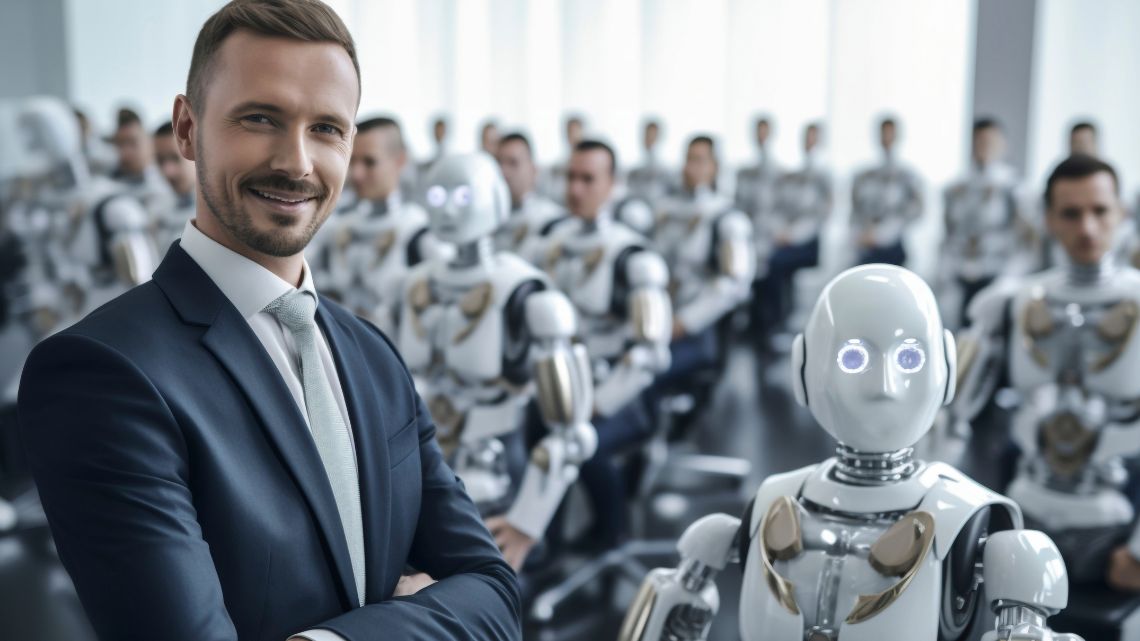
For decades, enterprise AI discourses have been aligned around a single strategic north star: automation. Although automation delivered measurable across organizational operations, the transformation of human-AI copilots helps build reliable decision pipelines, outcome precision, and long-term competitive advantage. Rather than leveraging technology as a permanent replacement for human labor, organizations can embrace it to develop intelligent human-AI collaborative frameworks. Human machine teaming states beyond a standalone technology genre, it is solely an organizational model that empowers scalable growth, strategic agility, and high velocity innovation.
What Does Human-Machine Teaming Really Mean?
Human machine teaming is a model of dynamic and bidirectional collaboration between humans and intelligent systems, designed to augment the operational and strategic workflows. While automation entirely replaces the human element in task execution, augmentation is enabling human’s enhanced tools to execute tasks. The primary differentiator in human-machine teaming is shared decision responsibility while maintaining a set of predefined boundaries.
Unlike the models of AI and machine learning copilots, where humans lead and AI assists based on context, system confidence, or environment, in human-machine teaming, there is no fixed hierarchy for decision-making; they compound one another for enhancing workflows. While human intelligence is catered as ethical reasoning, EI-driven management, and strategic judgment, technology facilitate pattern recognition, predictive forecasting, and data processing for streamlining workflows. Organizations that intentionally integrate human-machine teaming as a core strategy will strengthen workflow models, enable higher ROI, and enter enterprise-wide transformation.
Where Human-Machine Teaming Is Creating Real Enterprise Value
Operations and Supply Chain
- AI systems process forecast demand signals and optimize inventory management
- Intelligent analytics identify a machine’s operational parameters before any disruption escalates
- Collaborative robotics improve workflow efficiency and reduce manual complexity
- Human oversight supports strategic adjustments and complex decision-making
- Businesses gain enhanced operational agility and faster response capabilities when human judgment support tackles contexts outside of machine training
Financial Services and Risk
- AI can detect fraud and anomalies by analysing massive amounts of data patterns
- Intelligent models improve risk assessment and compliance monitoring
- Real-time anomaly detection strengthens financial security operations
- Human analysts provide contextual judgment and ethical evaluation
- Organizations achieve faster and more accurate financial decision-making
Customer Experience and Service Operations
- AI assistants manage repetitive customer inquiries at scale
- Intelligent systems deliver personalized recommendations and customer experience services
- Human employees focus on complex interactions and relationship management
- Businesses improve service responsiveness and operational scalability
- Collaborative intelligence enhances customer satisfaction and brand trust
What Effective Teaming Actually Requires Organizationally
Role Clarity and Decision Architecture
Successful human-machine collaboration in enterprise requires a strong organizational structure. The deployment of AI systems without clearly establishing the corresponding human role often leads to hurdles like accountability gaps, duplicated efforts, and workflows where humans’ presence fails to detect and act structurally when necessary interventions are required. Explicit decision architecture is integral for effective human machine teaming. It refers to developing a clearly defined document stating which decisions can be made independent of systems, which require human oversight, and under what scenarios those assignments change.
When employees are clear about their decision authority, the human-machine boundary remains robust throughout the environments of automation, analysis, and predictive processes.
Trust Calibration—In Both Directions
Trust is the cornerstone element of effective teaming irrespective of context. The two trust failure modes that create inefficiency and tension are automation bias and excessive skepticism toward machine-driven value creation.
While overreliance on machine intelligence causes operational hurdles and errored outcomes, undertrust may limit the adoption of growth-enabling behavioral change. Hence, deliberate intervention by demonstrating a balanced approach, ensuring transparency, explainability, and continuous learning, is substantial.
AI Readiness
Technology integration no longer determines AI readiness; it is the ability to optimize the optimal potential of artificial intelligence combining human efficiency through effective workforce training, digital infrastructure modernization, and leadership alignment. It’s important to evaluate factors such as data quality, model, and infrastructure maturity to the current market evolution.
Overemphasize on AI literacy limits broader growth. Organizations must focus on role clarity, how prepared teams are for tackling uncertainty, and organizational decision-making maturity. With the evaluation of such internal gaps, organizations a ensure seamless AI-Human workflow orchestration.
The Future of Human-Machine Collaboration
- Adaptive Teaming
Transcending the static models, the future of collaboration will be adaptive teaming, where systems dynamically adjust the human-machine boundary by learning the operational environments, human behaviors, decision stakes, and contextual signals. This helps achieve more personalized as well as responsive, autonomous workflows, enabling human employees to evolve in decision quality rather than operating within rigid structures.
- The Emerging Role of AI Orchestrators
As intelligent ecosystems provide a significant competitive edge in today’s ever-evolving business landscape, AI orchestrators play a crucial role in synchronizing human-machine roles. Orchestrators need to coordinate between human and AI systemic workflows by identifying the gaps in collaboration, ensuring accountability frameworks, systems thinking, and structural and operational alignment to translate outputs into hyper growth.
- Implications for Hiring and Organizational Design
Human-machine teaming is significantly augmenting the paradigms of hiring priorities and workforce structures. The quest is no longer what can be automated in the first place—it is how human capabilities and machine intelligence can be combined to create more reliable and scalable outcomes. The transition from traditional organizational hierarchies toward more flexible models such as remote work has reframed how enterprises can reduce cost and ensure expertise while maintaining structure across functions.
Conclusion
Human Machine Teaming is redefining the trajectory of how the businesses in this contemporary age are managed, as it integrates human abilities with intelligent systems in an unprecedented potential. The convergence facilitates improved decision making, accelerated innovation and ultimately increased flexibility across industrial operations. Instead of eliminating jobs, human-machine teaming enables enhanced agility in managing tasks and responding to market evolutions. Companies that deploy their AI-enabled capabilities into a human-centered context will obtain improved innovation cycles, scalability, and unlocks a competitive edge. As intelligent technologies continue to advance, organizations that create an excellent model for human-machine collaboration today will be poised to drive the future evolution of enterprise-wide operations.
To read more, visit APAC Entrepreneur.