
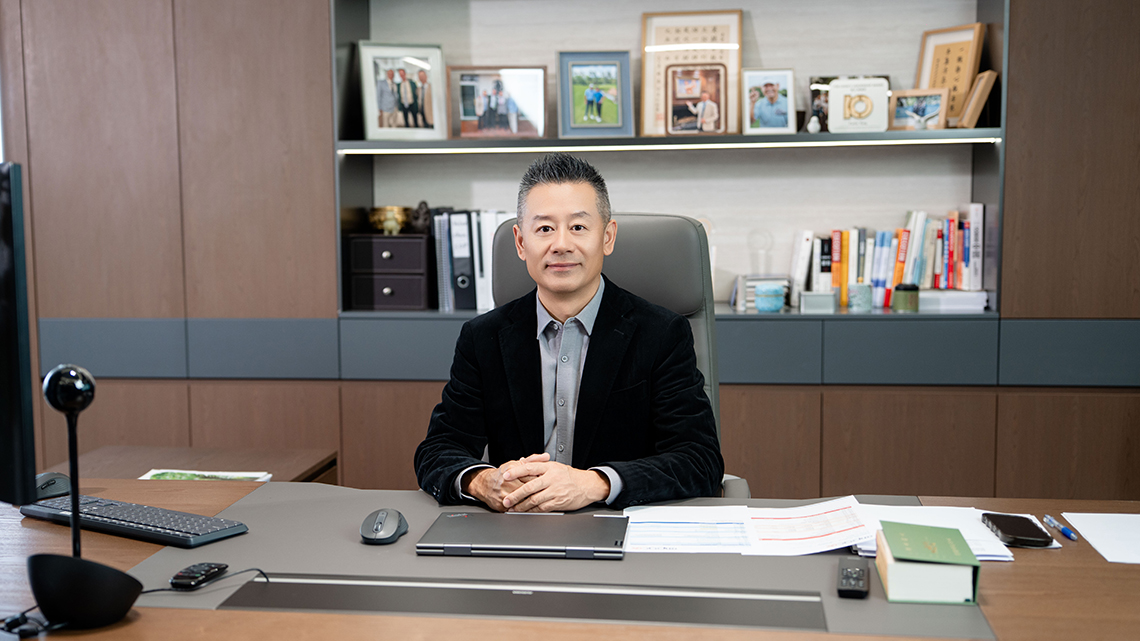
Carter Yang, MANAGING DIRECTOR, ALLEGIS GROUP CHINA
Entrepreneurship is less a career choice than a way of responding to pressure, how early responsibility is interpreted, how influence is absorbed, and how ambition is disciplined before it becomes indulgence. Long before outcomes are visible, certain people develop a bias for ownership, a tolerance for uncertainty, and an instinct to build rather than wait. Those instincts, formed well ahead of recognition, tend to explain far more about an entrepreneur than any milestone that follows.
Instincts like these hardly ever come fully formed; they are shaped early, tested, and carried forward with intent, long before leadership titles enter the picture. Today, those instincts guide the work of Carter Yang, Managing Director of Allegis Group China, where he has led the company’s workforce and business solutions operations across the China market since June 2016, overseeing regional strategy across people, operations, and customer experience, ensuring alignment between business performance, talent development, and service excellence. Yet the mindset that informs his leadership today took shape much earlier. Carter’s entrepreneurial orientation emerged not from a single defining decision but from an accumulation of responsibility, reflection, and an early resistance to drifting without ownership. What set him apart was a seriousness of approach, an insistence on understanding leadership before attempting to exercise it.
A leadership training experience in his late twenties proved catalytic. It dismantled the assumption that management and leadership were interchangeable, replacing it with a sharper truth: businesses are built on people, not processes, and authority carries consequence. Leadership, he realized, was less about direction and more about accountability – to values, to decisions, and to the people those decisions ultimately affect.
That sense of responsibility was deeply rooted at home. His mother’s discipline and work ethic established rigor as a baseline, not a virtue. His father’s artistic spirit encouraged him to think beyond structure, while the kindness of his siblings reinforced empathy as a strength, not a concession. One sentence, often repeated by his mother, stayed with him: “You belong to a bigger world.” It was not reassurance; it was a mandate. By his mid-twenties, those influences had converged into action. Entrepreneurship was not an experiment; it was alignment. As Carter reflects, “Before you build anything outward, you’re forced to build clarity inward.”

The Fundamentals That Decide Longevity
Before stepping into the role he holds today, Carter’s professional path was defined by deliberate exposure and early responsibility. In his formative years, he built his foundation across several leading European and U.S. organizations spanning multiple industries, gaining first-hand insight into global management systems, operational discipline, and professional standards. Yet structure alone was never enough. At 26, Carter made a defining choice: to start from zero and build something of his own.
What followed was not a linear ascent, but a demanding period of entrepreneurship marked by risk, learning, and relentless execution. From founding a business from the ground up to later partnering with a UK-headquartered publicly listed professional service company, Carter played a central role in scaling these operations from inception to national leadership, setting industry benchmarks and creating what many would come to regard as a reference case in the market. These early years forged his reputation not only as a builder but as a leader fluent in both strategy and execution.
Equally important was his ability to translate experience into insight. Beyond hands-on operations, Carter developed a disciplined approach to leadership and enterprise management, allowing him to step back, reflect, and systematize what truly drives sustainable growth. This capability has been further tested through the successful restructuring and integration of multiple organizations, turning challenged businesses around and positioning them for renewed growth.
After two decades of building from the ground up, Carter is unequivocal about what cannot be compromised when starting and scaling a business. Everything begins with real customer value, not the abstract kind promised in decks, but value felt, delivered, and reinforced through exceptional service. Without that, growth is cosmetic, and loyalty is fleeting. Customer experience, in his view, is not a function; it is the business. The second non-negotiable is accountability, carried fully and without delegation. The founder is the gatekeeper of decisions, costs, and consequences. That weight intensifies with each hire, when responsibility extends beyond revenue to the livelihoods and social security of people who have placed their trust in the enterprise. Ownership becomes personal.
To balance both customer value and responsibility, Carter insists on lean, disciplined systems. Especially in the early years, founders must stay close to the ground, micro-interested, detail-oriented, and hands-on with the engine. Scale comes later; integrity comes first. As he puts it, “If you’re not willing to own every outcome, you’re not ready to build something that lasts.”
The Cost of Building With People
In a service-driven business, the defining challenges are rarely about markets or strategy; they surface in the human core of the organization. Allegis Group was built on this belief. Founded in 1983, the company has always defined itself as a people business–one where success is driven not by products or platforms, but by the quality of relationships, the development of talent, and the responsibility leaders carry for those who place their trust in the organization. When Allegis Group established its presence in China through the Allegis-BN joint venture in 2008, it brought with it a philosophy that growth must be anchored in people, not scale alone.
It was this conviction that drew Carter to Allegis Group. For Carter, people are the primary asset, and therefore the greatest responsibility. Hiring, training, and developing talent demands sustained investment: emotional, financial, and operational. Early in his leadership journey, each departure registered personally. He had invested deeply, time, energy, and trust, only to see people move on. What weighed most heavily was not the attrition itself, but the realization that commitment and effort cannot always guarantee continuity. In a people-driven industry, leadership means accepting that reality while continuing to invest in those who choose to grow alongside the organization.
That perspective didn’t hold forever. Experience forced a reframing. Organizations, he came to see, move like trains. People board, people disembark, each at their own station. Permanence can’t be enforced; growth can only be enabled. The work, then, is to build an environment where people contribute meaningfully and leave better than they arrived. Accepting that truth marked a turning point. Setbacks became teachers rather than threats. As Carter reflects, “You don’t lead by holding on, you lead by letting people move forward, even when that path diverges from yours.”
The Long View on People and Energy
For Carter, the belief that people are everything was not a philosophy he adopted early; it was a truth that revealed itself over time. In his early twenties, his priorities were straightforward: work relentlessly, earn well, and build stability in Shanghai. But as his businesses grew, so did his understanding of what actually sustains them. Customer promises, service quality, and long-term scale, none of it moves an inch without capable, aligned, and motivated people behind it.
That realization widened his definition of “people.” It was never just employees. It was customers, candidates, consultants, partners, and an entire ecosystem bound by trust and effort. Along the way, Carter became convinced that most individuals operate far below their potential. A Chinese proverb he often cites captures this belief: “Three ordinary craftsmen together can equal the wisdom of Zhuge Liang.” Leadership, then, became less about direction and more about creating conditions where collective potential could surface. “My job is not to be the smartest person in the room, but to make the room smarter,” he shares.
Sustaining that clarity over decades required a parallel shift. Years of nonstop work eventually took a physical toll, forcing a reset. Today, Carter treats energy as a leadership asset through disciplined health routines, mental presence, and what he calls work–life harmony. Not balance, but flexibility. Not guilt, but responsibility, owned fully, wherever it demands attention.
A Legacy That Outlasts Titles
The impact Carter hopes to create is guided by a steady set of values, gratitude, contribution, excellence, and humbleness, that shape both how he leads and how he defines success. In his role leading Allegis Group’s workforce and business solutions operations across the China market, these principles inform not only how teams are built but also how the organization approaches clients, candidates, and long-term growth. They also explain his strong alignment with Allegis Group itself, where values are treated not as slogans but as operating standards.
Today, Carter’s focus extends beyond business performance to coaching, leadership development, and setting visible examples of how organizations can scale while still empowering people at every level. That approach has also been reflected in a number of industry recognitions. Among the most notable are Allegis Group being named China’s Most-In Global Talent Service Organization by LinkedIn, recognition among the Top 100 Human Resources Companies in Shanghai, and the Outstanding Company Greater China 2024–2025 and Outstanding Executive Greater China 2024–2025 honors by Greater China Business.
Yet for Carter, legacy remains personal rather than institutional. “Influence matters more than recognition,” he says. He often compares leadership to planting trees, patient work that, over time, becomes a forest. If he can help others grow and guide future leaders to do the same, the ecosystem will continue to flourish long after individual achievements fade.
Work Begins and Ends with People
Advice for early-stage founders is often framed around speed, scale, or technology. Carter takes a more grounded view. He operates in an industry where success ultimately depends on people. Technology and change are essential in modern organizations, he acknowledges, but they only create value when anchored in a deep understanding of human behavior. People’s needs, motivations, and aspirations must shape how systems are designed and how decisions are made.
For Carter, leadership is fundamentally environmental work. His responsibility at Allegis Group is not simply to manage outcomes but to cultivate the conditions where individuals and teams can thrive. He often compares it to tending soil, air, and moisture: when the fundamentals are healthy, growth follows, whether someone is just beginning their career or already experienced. In the talent industry, especially, he believes leaders must recognize that individuals often hold far more potential than what initially appears on the surface.
Looking ahead, Carter’s focus remains on strengthening Allegis Group’s role in shaping the future of talent across China and the wider region. As businesses navigate technological disruption and evolving workforce expectations, he believes organizations must rethink how they attract, develop, and empower people. Building environments where individuals can grow alongside the business, while maintaining a strong human center, will define the next chapter of leadership. Ultimately, the role of a leader is to unlock potential rather than constrain it, to build workplaces where people feel supported, energized, and fulfilled, and to surround oneself with partners who elevate one another. As Carter puts it, “Sustainable success is never built on systems alone, it’s built on people who are allowed to become their best.” At the end of the day, the principle guiding his leadership remains simple and non-negotiable: people are everything.
About Allegis Group
As the global leader in workforce and business solutions, we take pride in what we do, connecting great people to great opportunities, helping businesses win and careers soar. Today, with over 14 billion US dollars in revenue and 500+ global locations, Allegis Group and its network of specialized companies provide a full suite of complementary solutions that solve nearly every workforce challenge to empower business success while consistently delivering an unsurpassed quality experience. Our companies include Aerotek, TEKsystems, Aston Carter, Actalent, Allegis Global Solutions, Major, Lindsey & Africa, CareerCircle, MarketSource, and QuantumWork.
Learn more at www.AllegisGroup.com