
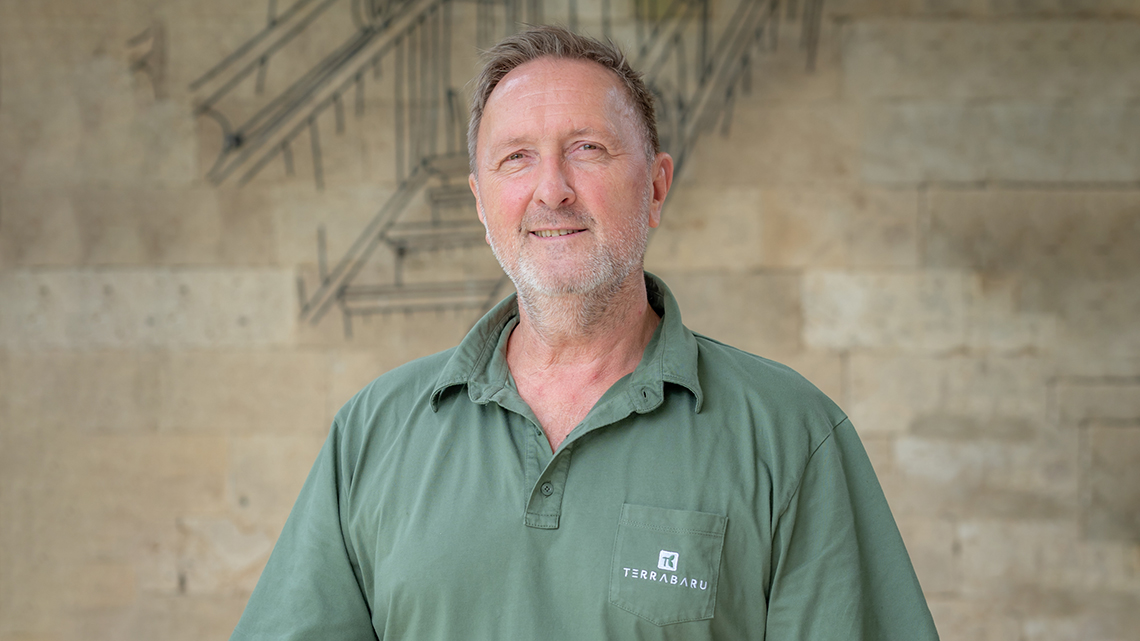
Bruno Wauters, Co-founder & CEO, TerraBaru
After thirty years at the relentless intersection of industrial mining, energy, and global consulting—building 27 operations across 11 geographies—Bruno Wauters reached a definitive moment of reflection. He wasn’t looking for his next acquisition or another corporate climb; he was looking for a legacy. Alongside his co-founders, Wauters looked at the staggering 250 million tons of agricultural waste rotting across the Indonesian archipelago and saw more than just an environmental crisis. He saw a “double problem” that demanded a singular, industrial-scale solution.
From Minerals to Microbes
The transition from industrial minerals to soil regeneration was a logical evolution of Wauters’ “waste-to-worth” philosophy. He observed an agricultural system in peril: twenty years of chemical fertilizer abuse had stripped the Indonesian soil of its life, leaving it exhausted and fragile. Meanwhile, the very biomass that could save it was being burned or left to rot, releasing carbon and choking the air.
This drive to build something meaningful was already taking root in 2017 when, as a father and entrepreneur, Wauters used his experience to build the Houbii brand—designing and operating sports and recreation facilities for kids “aged 6 to 66” across South East Asia. While market shifts eventually closed that chapter, the experience of building for the next generation remained. In 2023, TerraBaru was born from this realization, headquartered in Singapore and Bali. “Entrepreneurship is inevitable when you see a problem demanding execution,” Wauters reflects. The venture set out to use pyrolysis—the thermal decomposition of organic material—to turn that 250-million-ton problem into a high-performance solution that serves everyone from local farmers and plantation owners to mining companies seeking tailings remediation.
The Industrial Alchemist
Wauters is quick to distinguish TerraBaru from the “artisanal” biochar projects of the past. To make a dent in a global challenge, he knew he needed the weight of industry. TerraBaru’s strategy is a masterclass in circular economics, transforming a single source of waste into an integrated value proposition. At the heart of this process is Biochar, a “soil battery” with a surface area so vast that a single gram can equal a tennis court, allowing it to act as an exceptional carrier for nutrients and moisture.
Contrary to many biochar projects that rely heavily on carbon offsets, Wauters has built a business that is inherently sustainable through the sale of its industrial outputs: Biochar for soil health, Wood Vinegar as a natural pesticide, and co-generated energy. While the company seeks additional income through Carbon Removal (CDR) units where possible, the core engine is powered by the tangible value delivered to the agricultural market.
This technical innovation carries a critical sociopolitical weight. In an era where fertilizer has evolved from a simple input into a major financial risk, Wauters sees TerraBaru as a shield against global volatility. With persistent geopolitical tensions in the Middle East creating price uncertainty and exposing farmers to unpredictable external shocks, TerraBaru’s approach shifts agriculture away from a heavy dependence on imported synthetic inputs. By enriching biochar with locally sourced organic additives, microbes, and biostimulants, the company strengthens the soil’s natural microbial ecosystem and improves nutrient uptake efficiency. This isn’t just about soil health; it is about building systemic resilience that allows crops to thrive even when global energy markets are in turmoil.
The “Speed of Trust” in the Storm
Building a legacy is rarely a linear path. Wauters is candid about the “stressful cash crunches” and the cycles of expansion and contraction that defined TerraBaru’s early days. In an industry with unproven technology and a lack of data at scale, the only stable currency was trust. Wauters operates on a fundamental belief: “doing well so we can do good.”
The venture’s survival and subsequent growth have been fueled by a tight-knit network of support, starting with the co-founders, family, and friends. Critically, the mission gained momentum through a strategic partnership with Exmar NV. After investing in the initial validation phase, Exmar NV is now providing the essential funding for the industrialization phase.
Wauters leads a diverse team of 20 specialists across departments like Carbon Finance, Operations, Business Development, Finance, HR, Strategy, and Community Development through a philosophy he calls the “Speed of Trust.” He pushed his team to move from the “I need permission” side of the table to the “let’s do it and ask for forgiveness later” side. This culture of empowerment allowed the core team to stay through the “thick and thin” of the validation phase, turning a fragile start-up into a resilient scale-up.
The 2030 Horizon: Healing the Earth
TerraBaru’s story is now moving toward its most ambitious chapter yet: the goal to process 500,000 tons of agricultural waste annually by 2030. With a growth pipeline already covering 70% of that target, Wauters is looking toward early 2027, when a new industrial-scale plant capable of processing 15,000 tons of biomass will begin firing.
But the legacy goes deeper than the soil. Through the Yayasan Tiga Pilar Pertiwi non-profit, Wauters is ensuring that the “worth” generated from waste flows back into the community—supporting water sanitation and empowering the women farmers who are the backbone of the region’s agriculture.
A Mandate for the Next Generation
To the entrepreneurs standing where he stood thirty years ago, Wauters offers a challenge rooted in his own transition from operator to architect:
“Aim for scale from the start,” he urges. “Do not build for the present; build for the ambition. Give yourself five years to not just start a business, but to change a system. Raise for it, and build your teams and systems for the scale you intend to reach. Most importantly, on your path to success, do not forget gratitude.”
Bruno Wauters is proving that the future of the APAC market isn’t just in the tech we create, but in how we restore the earth that sustains us. At TerraBaru, the waste of yesterday is becoming the wealth—and the legacy—of tomorrow.