
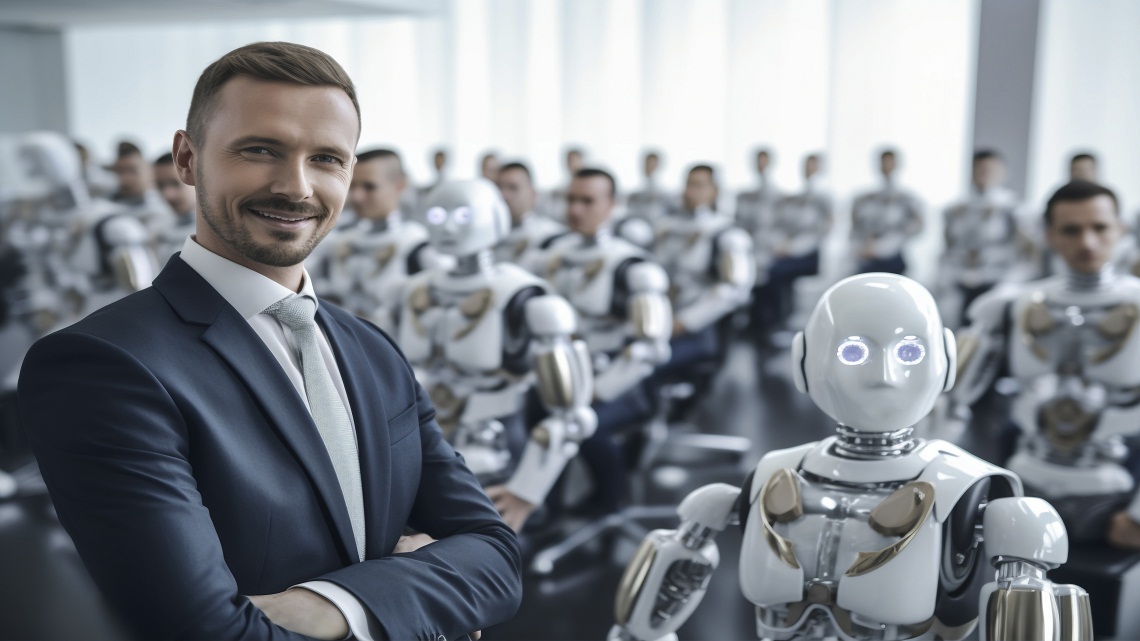
As the business world continues to change at an accelerated pace, it is crucial that leadership development moves away from the conventional leadership styles and prepares leaders for an agile, data informed and strategic foresight. The impact of Artificial Intelligence (AI) is substantially shifting the way leadership authorities make decisions, manage employees, collaborate and tailor development initiatives in alignment with their personal and professional goals without compromising on human core values. The integration of Artificial intelligence into existing leadership frameworks creates opportunities for organizations to develop agile, inclusive and futuristic leading capabilities in this age of disruption and digitalization.
What Is Artificial Intelligence in Leadership Development?
AI in Leadership Development signifies the application of cutting edge intelligent systems to identify performance, behavior data, figure out what knowledge-based skills are lacking compared to what would be considered competent for their position, and facilitate training and coaching recommendations that are personalized to every individual.
Traditional leadership development models have relied heavily on subjective methods of evaluation as well as static or fixed curriculums. With AI-supported leadership development models, organizations can cultivate:
- Personalized learning journeys
- Allocate ongoing feedback
- Analyze behavioral patterns
- Predictive talent planning
How does Artificial Intelligence promote leadership development?
- Personalized Leadership Development at Scale
Traditional leadership development models are centered on generic learning requirements and inefficient to address individual gaps. AI and machine learning algorithms help leaders expand their skills, leadership styles and strengths by meticulously assessing performance metrics, competency and behavioral patterns.
Customized learning and development training through generative AI recommendations and simulations support authorities in leadership roles that cover critical learning modules to guide and steer in a highly complex organizational landscape. Maintaining consistent development standards is one of the essential imperative especially in an era where leadership has a significant impact on business growth, sustainability and reputation.
- Real-Time Behavioral Feedback
Artificial intelligence tools copilots to advance leadership effectiveness in real time by facilitating objectives and immediate insights on a leader’s behaviors, communication and decision making potential. Integrating AI powered systems in communication tools and management will enable assessing factors such as:
- Tone and sentiment
- Participation dynamics
- Team responsiveness
- Task distribution indicators
With instantaneous and objectively assessed metrics, leaders are provided with actionable insights and 360 degree feedback to improve self-awareness and modify professional governance patterns, translating to higher engagement and communication effectiveness.
- AI-Powered Executive Coaching
AI powered training tools functions through methods of virtual simulations, scenario planning, personalization and real time data analysis. This allocates an effective pathway to understand and practice high stake conversations, effective decision making models under pressure, and learn how to modulate strategies potentially for different AI driven real life simulations.
Ai powered executive level coaching also combines programs that help manage tasks, collaboration and communication in remote and hybrid work settings, unlocking how to make decisions in a context driven, empathetic and in a goal aligned manner. Through guided reflection prompts, and progress assessment dashboards, AI accelerates the effectiveness of leadership training beyond fully replacing the human element.
- Data-Driven Performance Insights
AI platforms operate through the lens of precise data insights, which potentially contributes to providing effective development recommendations and leadership refinements, significantly more impactful than intuition based decisions. By enabling predictive analysis for identifying employee potential, engagement gap, leadership readiness, and challenges of burnouts and attrition, AI supports leaders to cultivate a strategic pipeline that helps mitigate the early warning signs.
Data filtered decision making insights help eliminate unexpected friction in management, foster focus, and allow leaders to establish long term resilience.
- Enhancing Emotional Intelligence with AI
While human intelligence surpasses components of empathy, contextual reasoning, sentiment understanding, AI serves as a diagnostic mirror, reflecting insights and details humans often overlook. In the context of leadership development, AI computing offers keen insights on interpersonal skills, biometric feedback, and evaluations on empathy and compassion in building a healthy working environment.
AI can be leveraged to assess:
- Bias in communication
- Conflict resolution simulations
- Rational behaviors
- Clarity and Tone
- AI in Succession Planning and Talent Identification
Predictive AI models identify competencies against strategic needs, performance patterns, and identifies individuals who demonstrate emerging leaders. Through comprehensive feedback, these AI frameworks in leadership development aids to map out the degree of candidate readiness, specially for technically demanding or roles in leadership pipelines.
By offering risk forecasts in precision, organizations can work on inefficiencies, early warning signs and enable HRS to cultivate a targeted development plan prior to major transitions.
Benefits of AI in Leadership Development
- Scalability across large organizations
- Cost efficiency compared to traditional programs
- Consistency in evaluation
- Continuous development
Conclusion
As organizations pursue future aligned leadership capabilities to continue thriving in an ever-changing environment, AI serves as a transformative measure to improve personalized development, provide real-time data insights for better decision-making, and support talent development. While AI is an excellent framework for organizational leadership development, responsible usage by combining the strengths of the AI system with the values of human intelligence will lead to forward-looking development. By investing in AI solutions that advance a transparent, more adaptable and efficient leadership training and development programs, it enables human leaders to map out stronger networks, effective support and elevate the potential of management success.
To read more, visit APAC Entrepreneur.